THE PARTICLE MODEL
Fixed, sliding or free
In a solid the particles are in fixed positions and vibrate. In a liquid they stay in contact but move past one another. In a gas they are widely separated and move at random.
Compare substancesSTATES OF MATTER, PLAINLY
Ice, water and steam are the same stuff.
What changes is how the particles sit and move. Locked in place, they make a solid; sliding past each other, a liquid; flying apart, a gas. Temperature decides which, and every substance has its own switch points.
Questions this page answers
0 · 100 °C for water
THE SHORT ANSWER
Shape, volume and squashiness
follow from the particle picture.
THE PARTICLE MODEL
In a solid the particles are in fixed positions and vibrate. In a liquid they stay in contact but move past one another. In a gas they are widely separated and move at random.
Compare substancesSWITCH POINTS
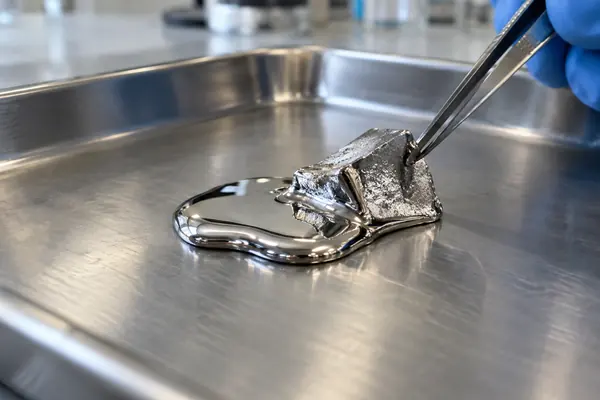
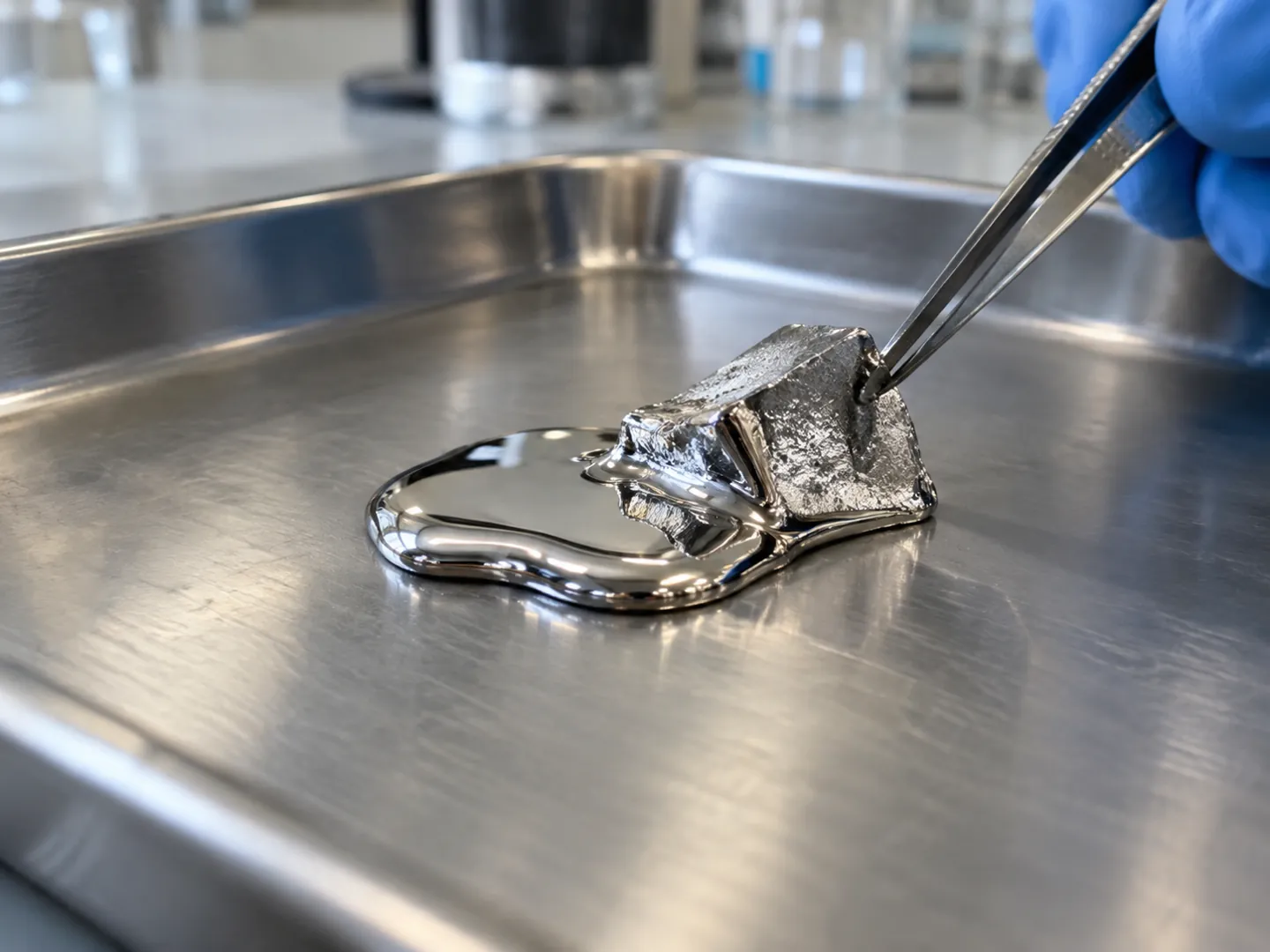
Water is liquid from 0 °C to 100 °C. Mercury stays liquid from −39 °C to 357 °C, and gallium melts at about 30 °C, warm enough for a hot day.
See the numbersTHE ODD ONE
Glass is an amorphous solid: no regular crystal pattern, but it holds its shape. Old panes are uneven because of how they were made, not because they flowed.
Read about glassA QUICK COMPARISON
Pick a substance to see where it melts and boils at normal air pressure. The bar shows how wide its liquid range is.
Figures from LibreTexts Chemistry, the University of Illinois physics Q&A (citing the CRC Handbook) and Chemistry World.
TWO NUMBERS WORTH KNOWING
One figure on how much room a gas takes,
one on how pressure moves a boiling point.
1,000× or more
Volume increase when a liquid boils
Going from liquid to gas increases the volume by a factor of 1,000 or more, because the particles move far apart. That is also why gases are highly compressible and liquids are not.
LIQUID TO GAS · LIBRETEXTS
≈ 95°C
Water's boiling point in Denver
Lower air pressure lowers the boiling point. In Denver, Colorado, water boils at about 95 °C rather than 100 °C.
BOILING AT ALTITUDE · ILLINOIS
Melting and boiling points are always quoted at a stated pressure, usually one atmosphere. Change the pressure and the switch points move.
FOUR THINGS TO NOTICE
You can see the particle model at work with things already in the house. Ask an adult before using a hob or kettle.
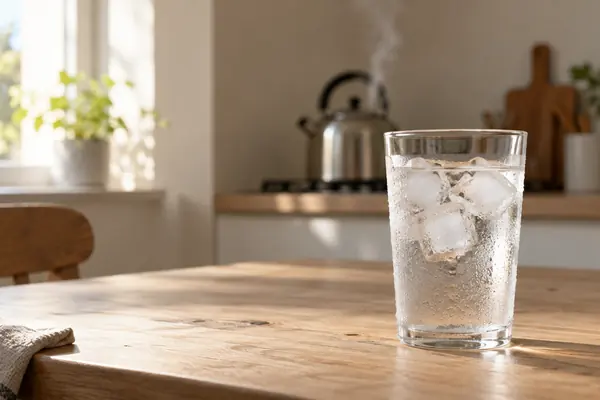
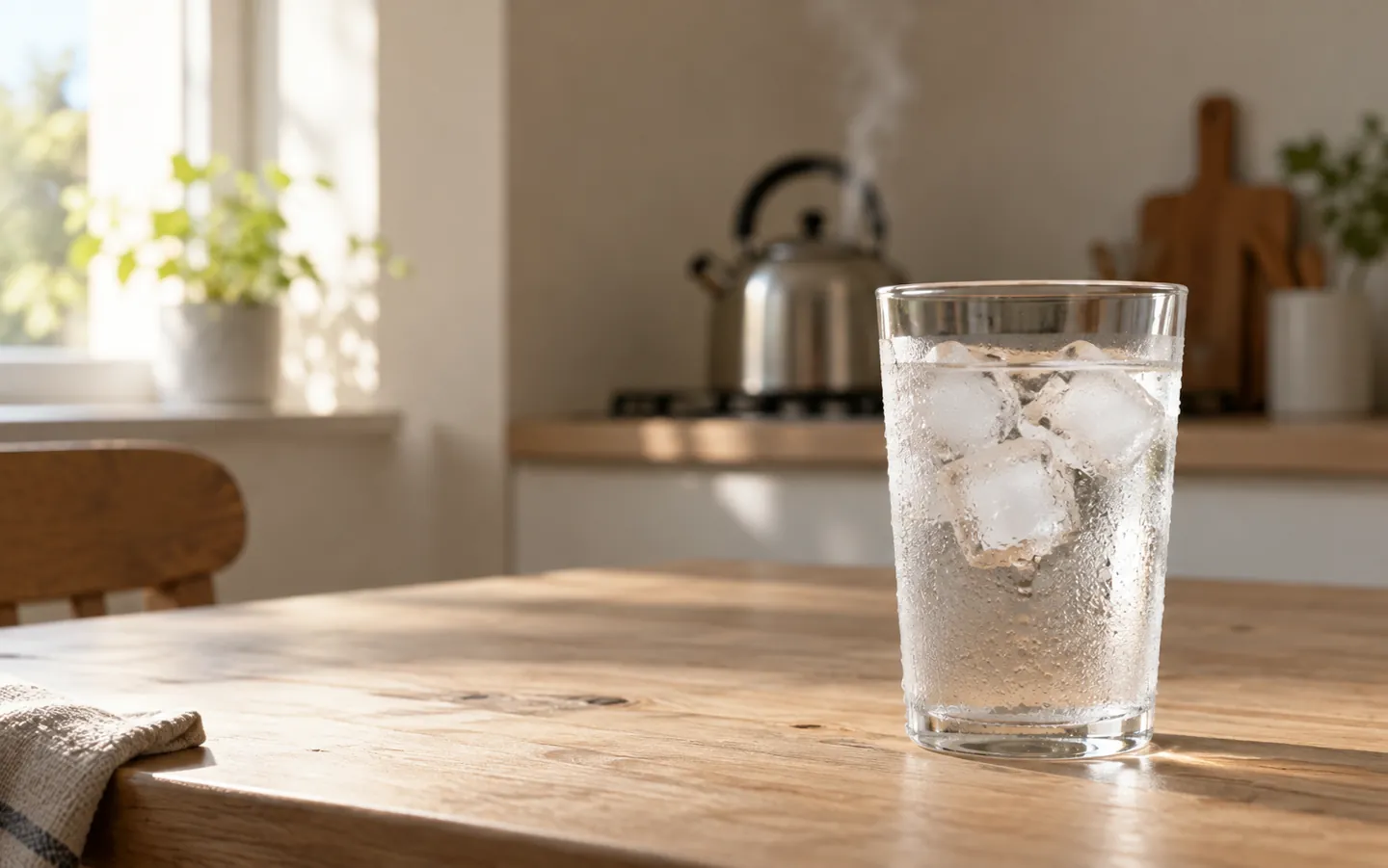
An ice cube sits in a glass as a cube. Its particles are fixed in place, so a solid keeps a definite shape and volume.
The same water fills a tall glass or a wide bowl. A liquid keeps its volume but takes the shape of its container.
Steam from a kettle spreads out and fades into the room. A gas has no fixed shape or volume and fills the space it is in.
Salt lowers the freezing point. Water with 29.2 g of salt per kilogram stays liquid down to about −1.85 °C, a little below plain water's 0 °C.

THE GLASS QUESTION
Glass forms when molten material cools fast and skips the regular crystal pattern. Chemists call it an amorphous solid. Quartz and window glass are both silicon dioxide, but quartz is an ordered crystal and glass is a random network.
The old story that cathedral windows are thicker at the bottom because glass flows does not hold up. A 2017 Penn State study of 13th-century glass at Westminster Abbey found that even nano-scale changes would take billions of years. Panes were uneven when made, and were often fitted thick edge down.
Questions
Solid, liquid and gas. A solid has a definite shape and volume, a liquid has a definite volume but takes the shape of its container, and a gas has neither and fills its container. Plasma is sometimes added as a fourth state.
It explains the states by how particles are arranged and move. In solids they are in fixed positions and vibrate, in liquids they stay in contact but move past each other, and in gases they are widely separated and move at random.
Freezing. The reverse, a solid turning into a liquid, is melting, and the melting point of a solid is the same temperature as the freezing point of its liquid: 0 °C for water at normal pressure. A solid can also turn straight into a gas without becoming a liquid first, which is called sublimation.
No. Glass is an amorphous solid: it has no long-range crystal order but holds its shape. Research on Westminster Abbey glass found room-temperature flow far too slow to change old windows.
A thick mix of cornflour and water comes close. Move your fingers through it slowly and it flows like a liquid; punch or squeeze it and it behaves like a solid, because the tiny starch particles lock together and the water is pushed into the gaps between them. The Institute of Food Science and Technology calls it a non-Newtonian fluid: unlike water, it does not keep a constant viscosity when force is applied.
Air pressure is lower at altitude, and lower pressure lowers the boiling point. In Denver, Colorado, water boils at about 95 °C.
Yes. Mercury is liquid at room temperature, freezing at −39 °C. Gallium melts at about 30 °C, so it can melt on a hot day.
Sources
ABOUT THIS NAME
doodlesolid.com is part of the DoodleSale portfolio. It isn't in an auction right now, but you can ask about leasing it.